Ever wondered what kind of footprint that was? What was growing in your backyard that made you itch? Or whether it's true that daddy long legs are venomous?
Look no farther than your local naturalists, the people at your Park District whose job it is to help you understand the natural world around you.
Simply click here to submit a question (preferably with a photo) to sward@geaugaparkdistrict.org and check back soon for a naturalist's response.
Q: I was out for a walk today (1/31/12) and found a caterpillar and was wondering what kind it is and what I should do with it. It is yellow and black. The yellow is on the sides and has what I call a black mohawk down the middle of its back.
I felt bad leaving it outside so I have it in a container with grass, twigs and some leaves. I have two boys, so I am more than happy to try and keep it but if it is not the best thing for the caterpillar, I will let it go. I tried to get a picture but it is pretty small, maybe an inch or so long. It does also curl up when you touch it and it's scared. Hopefully you can give me an idea what kind it is and what I should do.
A: I love a good challenge! This is a tough one, there are many, many species of caterpillars (larvae of moths and butterflies) in Ohio. The description you gave of this one did not jump out at me, and looking at a field guide of caterpillars didn’t bring any answers either. I know you said it was difficult to get a good picture, but anything would help. Also, if you happen to live near West Woods Nature Center in Russell township, you could drop it by for the naturalist staff to try to identify up close.
As far as taking care of it, it is likely it is overwintering as a caterpillar - they usually remain under ground cover or in trees or crevices during the cold months. As you know, this winter hasn’t been very cold. I would recommend not keeping it in your house, if it gets too warm it will need to eat, and seeing as though we don’t know what species it is, we can’t be sure as to what it’s food source is. Each type of caterpillar will only eat certain host plants.
Unless you really wanted to know what species it is, I think the best thing would be to release it back where you found it so it has a chance of going back to dormancy and if needed, finding it’s own food.
– Nora Sindelar, Naturalist
Q: Here's a picture taken from The Rookery's observation platform including some footprints (tracks) of an animal with rather small paws which placed its rear feet almost perfectly atop its front prints ... I have always thought such tracks were from a fox?
These tracks crossed the platform, stepped down and continued across the frozen wet area (unleashed).
A: It was a fox – most likely Red Fox with the tracks in a line, prints registering almost perfectly right on top of another to look like it was a one-legged animal hopping.
– Dan Best, Senior Naturalist
Q: I am not sure if you can answer this or not, since it is a mushroom that my cousin found in Louisiana. It is pretty strange-looking so I told her I would ask my park district because you have always answered my questions, and I appreciate it. Thanks so much.
A: A few seconds on Google Images under “red fungus" produced the below picture and ID from this site as red cage or red basket fungus.
The stubby white fungus looks like a mushroom nibbled at an early stage of its growth and thus is unidentifiable, to me anyway.
– Dan Best, Senior Naturalist
.jpg)
Q: How fast can a skein of geese fly - could they make it from New York to Chardon in a day's time?
A: Generally thought to fly 40-55 miles per hour at high altitude cruising speed. Airline pilots have seen them at 9,000 feet. Some estimate up to 70 miles per hour with a tailwind. Wind direction can make a big difference as in flying with the wind at their backs vs. a headwind. Then there is the whole issue of the V formation as a aerodynamic aid: maybe yes, maybe not.
– Dan Best, Senior Naturalist
Q: 
A: I am 100% confident that this is a juvenile Red-tailed Hawk.
– John Kolar, Naturalist
Q: This picture is of some sort of water plant in the creek near my daughter's house in southeast South Dakota. I'm thinking that this is something that would grow here, too. She thinks it may be some sort of water cress, but is not sure. Thought it would be fun for you to see if you can figure it out. Thanks again.
A: She is right – it is watercress!
– Judy Bradt-Barnhart, Naturalist
A: And yes, watercress can be found in local wet areas such as stream edges and wetlands. It normally grows in thick mats, just like in the picture.
– Denise Wolfe, Naturalist Administrative Assistant
Q: Are there pawpaw trees in any of the Geauga parks? Although it may be too late to get any of the fruit by now.
A: Yes there are, at Orchard Hills. However, please do not harvest anything natural from the parks. "Take only pictures, leave only footprints," as they say.
– Paul Pira, Field Biologist
Q: I found this feather while hiking near a covered bridge in Ashtabula County. Could someone help identify it? My first guess was a hawk or turkey buzzard, but given where I found it (in the gorge under a bridge) I'm thinking it is from a wild turkey.
A: You are absolutely right, it is a feather from a Wild Turkey!
To be specific, it is a wing feather and can often be confused with a hawk feather. Turkey feathers tend to be larger than hawk feathers, so this is one way to tell the difference between them. Vulture feathers are usually very large, light brown on the top and creamy white on the bottom.
Check out this photo of each for comparison.
Left to right: Red-tailed Hawk, Wild Turkey, Turkey Vulture

– John Kolar, Naturalist
P.S. In response to concern about the Migratory Bird Treaty Act, turkey feathers are legal to collect because they are a game bird. However, if you see them in the parks, let them (and all natural items) be where they are; take only pictures, leave only footprints, as they say.
Q: We have had this rock around the house for years. My granddaughter is very curious about it and wonders how the holes came about. This rock is about 3-4 inches long. Can you help?
A: It might be helpful to have more information about the rock. Could you tell us where the rock was found – habitat and geographic location? It is also hard to tell the texture of the stone. Is it gritty or smooth?
– Dottie Mathiott, Naturalist
Q: It was found in Bainbridge many years ago. My aunt in Bainbridge has a few of these, too. It is smooth, almost a sandstone look.
A: The rock is a limestone from the Michigan Basin. The holes are bored
into the rock by mollusks getting the calcium they need.
– David Saja, Curator of Mineralogy, Cleveland Museum of Natural History
Q: Hi, have seen this fungus or whatever on this same tree for the last few years. It is beautiful and I would love to know more about it. Thanks so much. Love asking you questions.
A: Looks like a northern tooth fungus, a large fungus that grows in the wounds of deciduous trees such as sugar maples (which the pictured tree appears to be, from the bark) and attacks the heartwood.
– Dan Best, Senior Naturalist
Q: Do you know why a particular type of red damselfly (I think it was a damsel) may have been so prevalent along the Walter C. Best Wildlife Preserve’s lake about a week ago? Possible hatching? Any idea what kind of damselfly I may be referring to? (I saw it again October 6 at Big Creek Park and took this picture; the little person is seen at right.)
A: These red dragonflies (I am sure they are dragons and not damsels) are most likely Autumn Meadowhawks. They are one or two of the latest flying dragon species, and some may persist into November if we don't have freezing or snow. They probably are still emerging from wetland areas and will do so until the weather does them in.
Geauga County has only one species of damselfly (Eastern Red Damsel) whose body is mostly red, and its flight period was finished in August. It is a very small damsel and very difficult to see because it usually flies low among sedges and rushes in pristine wetlands. It is also rare to uncommon, so it would not be one you would notice flying just anywhere. Hope this helps.
Also, the difference between dragons and damsels is that dragons fly and rest with their wings stretched out to their sides, and they have thick bodies. Damsels, on the other hand, rest with their wings above their abdomen. When damsels fly, you can hardly tell if they have wings - they look like colored flying straightpins. So the dragons are the B52 bombers and the damsels are the Cesnas.
– Linda Gilbert, Naturalist
Q: I found this on my porch. Looks like a huge wooley bearcaterpillar, but it isn't. After some research I found it on theHilton Head SC web site. It is native to the southern states. But here it is in beautiful ohio.
A: Leopard moths are quite common around here. In fact, Linda and I found a young caterpillar on the Meyer Center walk about a month ago. This is the time they start showing up, as they leave their host plant to look for a sheltered spot to make a cocoon where they will remain until they hatch into a moth in the spring. Yep, their bristles can cause irritation (but I doubt death, unless a very allergic reaction results).
– Tami Gingrich, Field Naturalist
Q: I'd like to know what environment does the chocolate tube slime mold live on?
A: This amazingly wet weather we’ve had has been great for fungus and slime molds. Slime molds belong to kingdom Protista, which also includes protozoans (microscopic, usually mobile, single-celled organisms) and algae. Slime molds have characteristics of protozoans because their microscopic cells are able to move (amoeba-like), but they also have characteristics of fungi because they produce visible, often colorful and oddly shaped fruiting bodies which produce spores. The tubes of the chocolate tube slime mold are a good example. Slime mold habitat includes cool, shady, moist areas on the forest floor under leaf litter and decaying logs.
– Linda Gilbert, Naturalist
Q: We were seining yesterday during our Kenston High School Biology II class (McFarland's Creek / Chagrin River) and caught a huge catfish. We at first thought it was a yellow bullhead; looking closer at photos we are wondering whether it was a white catfish. We did release it. Can someone help us with identification? Is this rare for this area? Thanks for your help.
A: Wow, that is a real keeper. I’m sure it was a huge surprise to your class. What you have caught is not a yellow bullhead nor is it a white catfish. What you have successfully seined is a Channel Catfish (Ictalurus punctatus).
This is one of Ohio’s most common native catfish. I typically see these fish in larger/slower waters like big rivers, farm ponds, lakes and reservoirs. They are also found commonly in Lake Erie and are often stocked in ponds and lakes. (Geauga Park District stocks them occasionally in some of our ponds.) It is rather interesting that you caught it in a smaller tributary; my guess is that it washed down from an upstream farm pond not too long ago. Find more information on this species at this link, and here:
The channel catfish is a popular sport and food fish. It is active during the night, moving around and finding food after dusk. During the day it will most likely be found in deep water with little activity.
Common Name: Spotted cat, silver cat, river cat, squeaker cat.
Description: The channel catfish, like other catfish, has no scales, a single bony spine in each pectoral fin and the dorsal fin, and 8 barbels around the mouth. They have a deeply forked tail and the upper jaw is longer than the lower jaw. The dorsal and pectoral spines are sharp and deeply serrated, and the anal fin is curved and has between 24 and 30 rays. The body can be blue, gray, silver or almost black. Their belly is usually white or cream colored. Small individuals are usually more silver in color and often have many black spots on their sides. Some anglers mistakenly call large channel catfish with few or no spots blue catfish, but the blue catfish has an anal fin with a straight edge and greater than 30 rays.
Feeding Habits: They are omnivorous and will eat a wide variety of items including insect larvae, crayfish, mollusks, fish (dead or alive) and even some types of fruits and berries.
Habitat & Habits: Channel catfish are native to Ohio and are found throughout Ohio in large streams, rivers and lakes. They are also stocked in many farm ponds where they do well but rarely reproduce. Channel catfish prefer areas with deep water, clean gravel or boulder substrates and low to moderate current. However, they are tolerant of a wide range of conditions.
Reproduction: Channel catfish begin spawning when water temperatures reach 70 °F. They use natural cavities, undercut banks and muskrat burrows as nests. The female lays a gelatinous mass containing between 8,000 to 15,000 eggs. Parents remain over the nest to fan the eggs and guard the young after hatching.
Typical Size: Typically 15-25 inches, can reach over 40 inches. Usually weighs 2-10 pounds, can reach over 50 pounds.
Please feel free to send any other puzzling fish pictures to me, too. Nice catch.
– Paul Pira, Park Biologist
Response: Thank you SO MUCH! I will pass the word onto the crew tomorrow morning! It was something I am SURE the students will remember forever, so very exciting! It was funny: we were just about to leave, and they were quite disappointed because the water was running so fast - none of the teams had done very well. Lo and behold, one team comes up with a trophy fish! :) If you want another view of the fish - I have them at the bottom of this school website.
Q: When I was a child, we used to call these Monkey Balls. What are they really?
Attached is a photo of Monkey Ball fruit growing in a tree, the bark from a Monkey Ball tree, and a green Monkey Ball laying on the ground. They are much bigger than a tennis ball. Thanks for identifying!
A: What you've photographed is an Osage-orange tree. Its strong wood is prized for making archery bows, and has also been used to make a natural yellow dye.
The fruits are thought by some to have an insect repellant quality; people have been known to place them around the foundation of their homes to keep insects out.
The fruits are also inedible, toxic and can cause vomiting and other adverse effects.
Like the Ginkgo, this tree is dioeceous, meaning there are separate male and female trees — and only the female tree produces the fruit.
– Denise Wolfe, Naturalist Administrative Assistant
Q: Could you please tell me what this “bug” is?
I find it very intimidating. :O
Was in a back yard in Middlefield/Burton area this weekend. Thank you in advance.
A: This is a very cool picture of a female Giant Ichneumon Wasp caught in the act of laying eggs. As you can see, the ovipositor (the long, threadlike structure) is very long (sometimes up to 4 inches) and is inserted in the tree trunk. Giant Ichneumons are predators of other wasps — particularly, the wood-boring Horntail Wasp. The ichneumon female searches for horntail tunnels in wood and then inserts her ovipositor into the wood and lays an egg next to the horntail larva. When the ichneumon larva hatches, it will then feed on the horntail larva.
This species is considered a beneficial insect, so hopefully its intimidating appearance has been somewhat dispelled. Type "Giant Ichneumon Wasp" in the search box of www.BugGuide.net for more information. Thanks for the picture!
– Linda Gilbert, Naturalist
Q: I assume this is a Garter snake. He is currently residing in the outer basement area of my garage. Assuming it is a Garter snake, should I be providing anything to help it survive the winter? Incidentally, I love that it seems to have taken up residence in my garage to help manage the field mice population. Thanks!
A: Yes, it’s a Garter snake, and he will more than likely take care of surviving the winter on his own. Many species of snakes overwinter inside burrows with other snakes.
– Denise Wolfe, Naturalist Administrative Assistant
Yes, snake’s choice of hibernacula, doubt it will be inside the garage. Foundation crevice, rock pile, mole or chipmunk tunnel, but somewhere subterranean. Not to rain on a snake-friendly person’s parade, but doubtful the garter snake is eating mammals, too.
– Dan Best, Senior Naturalist
Q: On Saturday evening, September 3, at about 7:00 p.m. we observed hundreds or maybe thousands of dragonflies in our yard and the neighboring orchard. What is happening? Mary Kay Simoni, Chesterland
A: Dragonfly swarms and dragonfly migrations are an amazing spectacle, so rare and difficult to predict that you may only have a chance to see one once in a lifetime. Lucky you, who were in the right place to observe the spectacle last week! Little research has been done, but we do know that dragonflies swarm as they begin to move south in late summer. Perhaps these groups of mostly Green Darner dragonflies gather in response to weather fronts and feed on gnats, mosquitoes and other flying insects they find on warm humid nights.
I did an informal survey at the Geauga County Fair on Sunday and found that people in Shaker Hts., Euclid, Munson, South Russell, Ashtabula County and Burton at the Fair also observed swarms of dragonflies Saturday evening! The majority of insects do not migrate and like the monarch butterfly, the dragonflies that move south do not return in the spring. I think it would be wonderful if someone would take on this phenomenon as a research study so we could learn more about this amazing migration!
– Dottie Mathiott, Naturalist
Q: Has the Monarch migration started yet?
A: Monarchs start moving south when the nights start to get cooler. They’ve already started their southern journey from Canada, so a few may come through this week (September 4-10), but the majority of them will come through mid-September – right in time for our Monarch Butterfly Tagging programs the next two Sundays, September 11 and 18. Start looking for them in greater numbers next week in your backyards and neighborhoods. They also like a north wind, which we’re getting right now, because they don’t like flying over Lake Erie against a south wind. The migration continues through roughly mid-October.
– Tami Gingrich, Field Naturalist
Q: What are these? Found them alive on the waterline at Headwaters Park.
A: OMG! Not again! Alien egg masses dropped by UFO's!
Seriously, they are freshwater bryozoans colonies. Here's a good definition of them:
Bryozoans are tiny colonial animals that are fairly common in lakes and streams with suitable habitat. Different species form colonies that range in appearance from delicate wispy moss-like growths to basketball-size gelatinous masses.
Each colony is made of many individual creatures called zooids. Zooids are microscopic cylindrical creatures with a mouth, digestive tract, muscles, and nerve centers. Different species are covered by a protective matrix which may be delicate, hard or gelatinous, and feed by filtering tiny algae and protozoa through a crown of tentacles.
Bryozoan colonies grow by budding from the adult zooids. New colonies will establish from a free-swimming, microscopic larval stage or by growth of dormant spore-like "statoblasts." Most Bryozoans live in salt water and, of the 20 or so freshwater species found in North America, most are found in warm-water regions attached to plants, logs, rocks and other firm substrates.
Or, as Park Biologist Paul Pira puts it, "This is not a fish at all but in fact a rather strange animal called a freshwater bryozoan (think freshwater sponge). They occur mostly in saltwater but occasionally are found in still, unpolluted, clear, silt-free freshwaters. They are very gelatinous and contain thousands of tiny individuals..."
East Branch Reservoir in Headwaters Park and Bass Lake Preserve are good places to find these creatures in the quiet water coves in summer. They are often found formed around submerged branches.
They are harmless to touch, but lifting the colonial masses out of the water may be harmful to them as their suspended weight may cause the colonies to tear apart. Removing them from the lake would also be fatal.
Examine, marvel and leave 'em be!
– Dan Best, Senior Naturalist
P.S. Here's a close-up of the zooids.
.jpg)
Q: Are you seeing Nighthawk migration?
A: Nighthawk migration is an annual but largely unnoticed natural phenomenon in our region.
Nighthawks are not hawks at all, but members of the “goatsucker” family (udderly preposterous, but the culturally persistent power of folklore has them using their wide mouths to suckle goats) that includes whip-poor-wills and nightjars. These long-winged birds share the evening skies with bats as predators of flying insects. One old name for them is the bullbat. They are among the most camouflaged of birds, nearly invisible when they hunker down length-wise to roost on a limb of a tree or nest on a gravel-top roof. In flight they show a distinct white patch at the wrist (or bend) in the wing.
Southbound migratory flights can be spectacular when hundreds of nighthawks move in swirling flocks at tree-top level foraging insects to fuel their travels, not at night like many songbirds but during the day. I remember watching one of these flights with my heart in my throat as these graceful but erratic (an oxymoron?) flyers careened in and out of high speed truck traffic along the I-71 interstate. The seemingly aimless nature of their travel – as opposed to straight line flight – belies the fact that the flocks are indeed moving south; south to South America, in fact.
As the nighthawk population has declined in recent decades, migratory flocks tend to be smaller: dozens rather than hundreds, but a spectacle none-the-less. Prime time for these flights through NE Ohio is late August – early September; County Fair time! Watch for them in your neighborhood around Labor Day weekend.
– Dan Best, Senior Naturalist
Q: My question regards birds. Up until yesterday (August 27) we had a robin feeding her brood in our magnolia tree. I was so surprised to see her feeding this late in the year. And, now today I see a morning dove in an ornamental maple next to our dining room window, and she is sitting on a next from earlier in the summer. She had at least one brood this summer. I can't believe she would be nesting again...it seems so late. What do you think? Thanks so much again.
A: Thanks for your question about late-nesting birds. It is not uncommon for some of our native birds (e.g. robins, cardinals, bluebirds, doves) to nest more than once during the nesting season. The pair of bluebirds at our building at The Great Geauga County Fair just finished their third brood! For mourning doves, in particular, Peterjohn’s The Birds of Ohio book says, “Many pairs make four or more nesting attempts annually and may continue into autumn; recently fledged young have been noted through early November.” It is not unusual, either, for some birds to re-use an old nest, so your mourning dove is taking advantage of that. Also, the cold weather at the beginning of the breeding season may have caused some birds to get a later-than-normal start on their nests this year.
Hope this answers your question! Let me know if I can provide further information or clarification.
– Linda Gilbert, Naturalist
Q: We were walking in Big Creek Park and wondered which direction (north to south or south to north) the creek flowed. We also were curious as to what river the creek’s water drains.
Thanks.
A: Big Creek flows from south to north through Big Creek Park. Small tributary streams flow perpendicularly through ravines to join Big Creek throughout the park. Big Creek’s uppermost headwaters are on the east side of the City of Chardon, south of US 6 (GAR Highway). Big Creek is, in turn, a tributary of the Grand River. It flows into the Grand in Lake Metropark’s Helen Hazen Wyman Park on the south side of the city of Painesville.
Hope this answers your question! Let me know if I can provide further information or clarification.
– Dan Best, Senior Naturalist
Q: We live on Caves Road in Novelty. Friday evening around 9 PM I was watching the sunset as dusk set in. Suddenly a canine figure jetted across Caves and sprinted between our house and our neighbor's. He/she was sprintin,g but I could see a mottled coat and it was big! I think between 30 and 35 pounds. The creature dashed into the tree line and was gone.
Are our five cats and cockapoo in danger? Any advice or information about coyotes in this area would be appreciated.
A: Based on your description, what you saw could be a coyote. I have copied the description published by ODNR Division of Wildlife below:
The coyote is generally a slender animal, very similar in appearance to a medium-sized dog. Since the coyote and domesticated dog are from the same family, Canidae, the resemblance is more than a coincidence. Coyotes have a bushy tail which is usually tipped in black and is carried down at a 45 degree angle as the animal moves. The majority of coyotes are gray, though some show a rusty, brown or off-white coloration. The coyote stands about one and one half to two feet tall and is between 41 to 53 inches in length. Males of this species are larger than the females and weigh anywhere from 20 to 50 pounds.
Coyotes are common Geauga County and throughout Ohio. Some other helpful information and advice from ODNR:
The coyote is a nocturnal animal, active during the nighttime hours. However, when it is less threatened by man, it will hunt and move from place to place during the day. The coyote will hunt in unrelated (non-family) pairs or large groups. The coyote's strength is that it can adapt and exploit most any habitat to its advantage. While most wildlife species have avoided developed areas and often declined as a result of man's expansion, the coyote seems to have thrived.
The coyote is omnivorous, meaning it will eat what's available: small mammals (voles, shrews, rabbits, mice), vegetables, nuts and carrion. They may prey on livestock, particularly sheep and chickens. The following should answer your question about danger to your five cats and cockapoo:
If you do have a coyote on your property, remove all “attractants." This includes not leaving garbage and pet food out at night and cleaning up around the grill. Coyotes prey primarily on small mammals such as rabbits and mice. Small pets are no exception to this diet. Keep small dogs and cats inside or stay with them at night when coyotes are most active. Coyotes are usually afraid of humans and will run away at the sight of people.
Please let us know if you have any further questions.
– Dottie Mathiott, Naturalist
Q: How many different species of moths and butterflies have been recorded in Ohio?
A: There were 144 species of
butterflies and skippers on the Ohio list when Iftner etal's book was
published in 1992. Since then we've added about a half dozen or so. As for
moths, they generally outnumber butterflies by about 15 to 1, so a ballpark
figure would be 2,250 moths and 150 butterflies and skippers, equaling 2,400 total. I think that's low. If I have an opportunity I'll plow through the Ohio
Lepidopterists' database and get a precise figure for species documented the
last time the database was updated. We are, of course, adding species
regularly, especially among so called "Microlepidoptera" - the smaller
moths. Some of these are not yet described and have no name, so a species list remains a moving target.
So there is one person's best guess.
– Dave Horn, leading Ohio entomologist and chair of the Ohio Lepidopterists Survey Committee
Q: I love that we can ask questions, and that you answer so quickly. The insect in the picture is approximately 1 1/2 to 2 inches long. I think it might be some sort of wasp, but that seems rather large. I can't find it in any of my books. Thank you.
A: What you have so photographed so well is a Giant Ichneumon Wasp. This is a large group of stingless wasps characterized by the females having a long (sometimes VERY long) hyperdermic needle-like egglaying tube called an ovipositor. Many of the ichneumons parasitize other insect or wasp larva by laying their egg in, on or near these larva, which are embedded well into the wood of dead or dying trees. These wasps with long ovipositors, especially the
very long ones, are pretty amazing as they drill (oil rig-like) into the wood to reach their targets. It is not certain whether the ovipositors actually “drill” the soft wood or follow cracks or the tunnels of the wood-boring prey larva. The eggs hatch and the ichneumon wasp larva lethally feed on the host larva, often from the inside out. In the case of giant ichneumon wasps, the prey is the wood-boring larva of another sting-less wasp, a horntail.
It appears as though your specimen lacks the long ovipositor, suggesting that it is a male. Click here for a website featuring a series of photos and a video showing the giant’s drilling operation in action.
Thank you for your inquiry, we appreciate your curiosity!
– Dan Best, Senior Naturalist
Response: THANK YOU! My grandchildren, 10 and 6, both love that we get answers to our questions.
Q: We found this snake on a path in the park on our walk. Do you have any idea based on the markings what kind of snake this was?
A: It is definitely a Black Rat Snake! This is Ohio’s largest species of snake, reaching an average length of 4 to 6 feet. According to the Ohio Division of Wildlife, some individuals have been known to exceed 8 feet. It is essentially a forest-loving snake that is an excellent climber. They are not venomous but rather kill by constricting their prey. The Black Rat Snake is a very beneficial reptile, playing an essential role in controlling rodent populations. Nice sighting!
– John Kolar, Naturalist
Q: At Beartown Lakes, was Minnow Pond developed at the time this was a fishing center as a hatchery pond?
A: Yes, Minnow Pond was there when we acquired Beartown Lakes, as were the other three Lakes. We just named them all. I vaguely remember an old lift net apparatus mounted on a long, see-saw-like levered handle at Minnow Pond that harkened back to Al Beiger’s fish hatchery operation..
– Dan Best, Senior Naturalist
Q: I saw this tall plant growing among (what I think are) some nettles and other woodland plants above the bank near a stream. I've included pictures of the whole plant as well as close-ups of its very unusual flowers and the foliage with stems arising from the leaf axils. The stem is interesting also as it has a square cross-section with rounded edges. Thank you for your help in ID-ing this plant!

A: It is Carpenter's Square, Scrophularia marilandica. I've seen it at Swine Creek Reservation before.
– Judy Bradt-Barnhart, Naturalist
Q: Can someone identify this bird? It perched itself on my son's golf cart the other day.
A: It's a young female Baltimore Oriole. Naively tame?
– Dan Best, Senior Naturalist
Q: My son, who lives in Munson, has a bird which I believe is a Junco which hung around his deck and would constantly go to one of the hanging flower baskets. She would get within two feet of them waiting while they watered the plants. He tried to look in the basket which was in full bloom, but couldn't see a nest. Lo and behold, his wife watered the plants this morning and, when she watered the basket, four or five little ones flew out. Scared her to death, but then she felt terrible and is worried that they will not survive. Momma bird came back, but they were gone. I am hoping that since they flew out of the basket and went into the woods, maybe they were about ready to "fly the coop" anyway. What do you think? I am hoping to make my daughter-in-law feel better about this. Thank you.
A: If the young birds are able to fly then they will be okay. The young will make little call notes that will help the parents locate them. The parents and young will hang out as a group for a while as the young learn how to get food on their own. So not to worry, sounds like everything is okay.
– Denise Wolfe, Naturalist Administrative Assistant
Q: How do you use your binoculars as a microscope, as mentioned on page 3 in " Up close with nature" in the new summer issue of Voices of Nature?
A: Turn your binoculars upside down and hold one of the ocular lenses (the lenses that you usually look through) very close (less than an inch) to the object that you'd like magnified.
With one eye, look through the large objective lens on the same side as the ocular lens you are using. You should be able to see a magnified view of the object.
You really need to get very close to the object, so if it doesn't seem to be magnifying then you need to move the ocular lens closer to the object until it appears to be magnified.
Good luck!
– John Kolar, Naturalist
Q: Should we clean our boxes out when our bluebird babies fledge? When is the best time to do that? Thanks!
A: Absolutely. As soon as the young leave the nest, the box should be thoroughly cleaned. Once the babies fledge, they do not return to the nest again. Bluebirds will next up to three times in a season. If the old nest remains in the box, they will find another cavity in which to nest. If it is cleaned out, they will build again in the same box.
– Tami Gingrich, Field Naturalist
Q: I am trying to find a good, complete plant identification book for the area. One that would contain most ground level plants as well as trees (native, naturalized and invasive). Im a college student (Ecology major) and am specifically looking for something with a good dichotomous key that's organized taxonomically. Do you guys have any recommendations?
A: Not sure about a good “catch all” book, but I strongly recommend Newcomb’s Wildflower Guide. It gets most herbaceous plants, with the exception of grasses, which are a whole world of their own. It also covers many flowering shrubs and vines. Newcomb’s is great in the field for amateurs on up. Voss and Gleason are two authors of much more technical books with keys, but they are pretty cumbersome for casual field use.
– Bob Lange, Land Steward
Unfortunately, there is no one all-inclusive good book. I use a number of books. To start, a general, all-around basic field guide for herbaceous plants is Newcomb’s Wildflower Guide…handy little guide in the field. Four more technical resources:
- Michigan Flora (all 3 volumes) by Edward Voss
- The Vascular Flora of Ohio (3 volumes) by L. Braun, etc.
- Plants of PA
- Manual of Vascular Plants of NE US and Canada by Gleason and Cronquist (2nd edition, also get the illustrated companion)
– Paul Pira, Park Biologist
Q: I was canoeing around East Branch and took note of all the conifers around a few areas of the shore. It looked to me like they were eastern white pine, eastern hemlock, and one other type of pine (with two needles per bundle). Are my ID's correct? And what is the other pine with two needles, likely? Are these trees native, planted or what? And if non-native, are they ecologically problematic at all?
A: The other two-needle/bunch pine is most likely red pine. Red pine, white pine and Norway spruce were planted at East Branch Reservoir at Headwaters Park no doubt as part of a reforestation effort by the City of Akron, perhaps with the assistance of the state forester for Geauga County in the 1950’s, maybe earlier. Reforestation with non-native conifers was a widespread practice in Geauga County in the last century.
Ecologically, they have not proven invasive, as they do not reproduce prolifically. The pine and spruce stands have, in fact, attracted the Pine Warbler (a southern bird species) to nest, as well as such northern birds as Blue-headed Vireo, Red-breasted Nuthatch and Black-throated Green Warbler, which tend to favor coniferous forests.
– Dan Best, Senior Naturalist
Q: I pass this tree every day on my way into work, and suddenly so many of its leaves are covered in these raised cortortions. Some are kind of reddish, others just a lighter shade of the leaf's green. Can you please tell me what causes them?
A: They are called Cockscomb galls and are caused by a species of aphid specific to Elm leaves.
You can read a little more on them at this link.
– Linda Gilbert, Naturalist
Q: Today we saw what appeared to look like a raccoon, however it was reddish brown and the ringed take was reddish brown and a lighter brown. Not like the black and white of raccoons. Can you identify what it could have been? Thank you.
A: You probably did see a raccoon, although without a photo it is hard to say for certain.
Raccoon color is variable. They typically have a black mask around their eyes and the black rings around the tail, but raccoon fur is a mixture of various colored hairs ranging from brown and black to yellowish and reddish gray. Their back is usually darker than the underparts. Occasionally even white or very dark individuals are found, and I suspect what you saw was one of the variations that was lighter than the normal color.
If you get another sighting, send us a photo so we can tell for sure, OK?
– Dottie Mathiott, Naturalist
Q: I found these tiny little frog / toads at Walter C. Best Wildlife Preserve on Saturday, June 11. They have grey bellies but a soft, white, looks-like-flexible area under chin like it could expand but just flickers as they breath. They are a brownish color with six to eight black spots on their backs that run from head to butt. It is hard to tell what they are because all the information I have found gives size descriptions of frogs and toads as adults, but these must be babies because you can see a little bump of a tail still left on them. They are tiny, could probably fit two of them on a dime. What are these cute little guys or girls and what do they eat? What is there typical habitat, and can they swim? I apologize for not having any pictures. I hope my description will be enough for you to identify them for me and my children. Thanks, Curious in Chardon
A: Sounds like you experienced a “Toadlet Invasion”! Around this time of year, from late May through mid-summer, the American Toad (Bufo americanus) tadpoles are completing their transformation from eggs that were laid in the spring and are now trying out their new legs and hopping out of the water into forests, fields and backyards.
They go to the ponds to mate and are able to swim, however they do not prefer aquatic habitats. They no longer eat vegetation as they did as tadpoles, but dine on small critters such as earthworms, slugs and insects.
The best thing you can do to help them out is to leave them be to enjoy the adult stage as a toad. They can completely fend for themselves and are best left where they are. It is not advisable to keep them as pets, and actually requires a permit from the Ohio Division of Wildlife.
So resist the urge to keep these cute little guys, because you can count on seeing them every year at this time as long as they have great places to live and grow.
– Nora Sindelar, Naturalist
Q: This snake was spotted on Brigadoon Drive on 5/22/11 at around 3:30 p.m. It moved back into the grass and appeared to be around 2 1/2 feet long. What type of snake is it?
A: It's a Milk Snake.
– Denise Wolfe, Naturalist Administrative Assistant
Q: I am trying to combate the patches of garlic mustard along my road, and I have to ask – what should be done with it after it is pulled? Where can I take it? I want to be as responsible as possible with this, so please let me know! Thanks!
A: Depending how much there is, it can be bagged in black trash bags, tied tightly and left in a sunny location over the summer. I have found that it pretty much rots down to mush, which can then be added to a compost pile.
Or it can be composted directly by burying it deep in a good, hot existing compost heap. Or some agencies bury it in the ground a couple feet deep. Or it can be bagged and sent to a landfill.
If it has produced mature seed already (which usually is not until early June), it is especially important to make sure it is heated well to destroy the seeds.
– Bob Lange, Land Steward
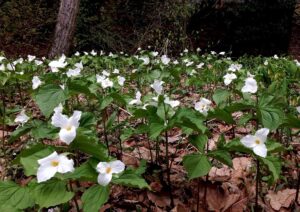
Q: I attached a photo of a unique trillium I spotted today in my parents' woods. I have never seen a trillium like this. Would anyone have any further information? Thanks!
A: Good to hear from you. I sent your trillium picture to someone who knows trilliums well, and here is his response.
Yes, this is written about in Fred Case's book among other places. It is an infection called microplasia. It is well known. It manifests as various markings such as stripes, blotches, even multiple tepals - often with reduction and/or elimination of reproductive parts. Usually these specimens are not fertile. I knew of a woods in upper Michigan that was heavily infected. One could see up to 12 petaloid tepals often in various colors and patterns, even herringbone. I have some nice old slides of same.
– Judy Bradt-Barnhart, Naturalist
Q: Are dandelions native?
A: Dandelions are not native. They were brought over here from the Old World as a food source. They are also not on the invasive list, as they don’t get into natural areas. And while many people consider them invasive in their lawns, grass is not native either!
– Judy Bradt-Barnhart, Naturalist
Q: Would you happen to know how old Rocky Cellar is? It is located on Downing Drive in Chardon. The back is almost identical to that of Nelson Ledges State Park, and if formed in the same era, could it be 20,000 years old? How would one go about determining if, in fact, this could be deemed comparable to a State Park, thus providing protection? There are caves, and it is rumored that one cave was blocked off, but at one time it was a tunnel to the Chardon Courthouse. Is it possible that there could be sink holes? The basin of Rocky Cellar is massive. Could there be other caves connected? This is coupled with the fact that it is home to numerous animals. I have seen hawks, eagles, Pileated Woodpeckers, salamanders, owls, rabbits, fox, deer and box turtles. There are also Jack-in-the-Pulpit.The list is endless. I fear it is in grave danger with a city project.
A: Rocky Cellars is part of the rock exposures that run along the eastern slope of the bedrock knob Chardon sits atop. A popular misconception is that these sandstone ledges and gulleys/gulches were formed by the glaciers. Not so. It predates the Ice Age (and the Age of Dinosaurs for that matter) by hundreds of millions of years.
The rock is Sharon Conglomerate: a course-grained silica sandstone with water-rounded quartz pebbles embedded in it. The pebbles were tumbled smooth in the swift mountain streams of an ancient river system that existed some 300 million years ago. These streams hit a flatter terrain near sea level in this region and the streams spread out – or “braided” – across an extensive area depositing the sand and pebbles far and wide.
Over the eminent amount of time (tens of millions of years), these sediments were covered by other sands and muds as land subsided below sea level. Following that, the sediments lithified into sedimentary rock. Once again, geologic upheavels brought our region permanently above sea level and a long, long period of erosion ensued. The erosion created stream systems that carved our “hill and dale” landscape in Geauga County leaving the uplands capped in Sharon Conglomerate. Many of our towns are found on these uplands or hilltops. Hence, the Chardon Hilltoppers!
Along the edges of these conglomerate knobs, rock broke along weaknesses called faults (we all have them, even rocks). Over time, the downhill portions of the rock separate and creep downhill leaving wide cliff-like corridors, wide cracks, narrow crevices and even “natural bridges) between them. Some deep crevices even form cave-like voids. In some areas, post glacial streams eroded away conglomerate too to create ravines among it. Rocky Cellars is one such place.
In fact other regional Sharon Conglomerate outcroppings/ledges include Thompson Ledges Township Park, Ansel’s Cave here at The West Woods, Little Mountain (Holden Arboretum), Nelson Ledges State Park, Virginia Kendall Ledges (Cuyahoga Valley National Park), Whipps Ledges (Hinckley Reservation, Cleveland Metroparks), etc.
I have heard some of the legends and rumors regarding Rocky Ledges that you mention, such as the supposed tunnel from the courthouse, that important documents were hidden in Rocky Cellars, etc. Although crevices in the Sharon Conglomerate can be large, they shortly peter out and are not well connected like true cave systems and sink holes in limestone formations that are the result of chemical dissolving of the rock.
These Sharon Conglomerate outcroppings and ledges each have their own lore and legend, with names like “Devil’s Kitchen” or “Devil’s Ice Box” or “Robber’s Cave” that hint at the crevices leading to the gates of hell or as hideouts for hermits, outlaws, run-away slaves, etc. Such names as “bear caves” or “wolf den rocks” do have plausibility as one-time lairs for such large predators.
I would be extremely grateful if you shared whatever rumors or stories that you’ve come across regarding Rocky Cellars as, in adding color to our local natural history. I’d also be grateful for the opportunity to see Rocky Cellars again. It’s been many years.
Thank you very much!
– Dan Best, Senior Naturalist
Q: I live in Mentor-on-the-Lake and find a ton of neat bones and such on the beach, some of which I've been able to identify, but these teeth I found last year take the cake. The two pictured here (I make jewelry for a living and turned them into necklaces) are the longest I have.
My collection is home to 2-3 smaller/narrower teeth, but they appear to be the same variety. Any ideas what they might be? I've looked at so many animal and fish teeth the last few days trying to identify them! The closest I've come is to Northern Pike (though the big tooth, which measures 2.5 inches, would have had to come from a REALLY big fish!). Thanks for your help!
A: What you have there are fish bones, not teeth.
– Dan Best, Senior Naturalist
Q: Here is a picture I took in my backyard today. I believe it's a red squirrel?
It is quite small like a chipmunk but it has a bushy tail like a squirrel.
A: Yes, this is indeed a red squirrel. They are very cute and very active little mammals.
Red squirrels go by many nicknames, such as "boomer" (for their loud barking/chipping vocalizations), and my grandparents from the mountains of West Virginia called them "fairy diddles" (though I don’t have any idea what the significance of that name is).
– Denise Wolfe, Naturalist Administrative Assistant
Q: What kind of woodpecker is this?
There was actually a pair of them in our backyard in Bainbridge Township. I was very surprised by the size of this bird. Thanks!!
A: That's Woody Woodpecker's alter-ego – the Pileated Woodpecker.
Learn more about that species at this link, and make sure you listen to the call. Once you can identify it, you'll be hearing them all the time in the distance.
– Tami Gingrich, Field Naturalist
Q: What kind of woodpecker is this?
I saw it on my backyard feeder in Chagrin Falls.
A: You spotted a Northern Flicker.
Learn more about that species at this link.
– Tami Gingrich, Field Naturalist
Q: We have this squirrel in our yard that has these black patches all over his back. It looks like his fur is missing in these areas.
When I first saw it, I thought it might just be a mix between a black-colored squirrel and a brown-colored squirrel. But after looking closer, it actually looks like his fur is missing.
This is not in a park, but I was hoping you could tell me if it has some disease or what might be wrong with it.
A: Mmmm…looks like mange. We often see this in late winter. Mange is caused by mites and can be passed along to other wild mammals and pets through direct contact. Infected animals suffer itching and scabbing.
For wild animals like squirrels, raccoons, fox and coyote, winter mange is often fatal due to exposure with loss of insulating fur. But if the animal can make it through until the return of warm weather, it may survive to recover.
– Dan Best, Senior Naturalist
Q: I was just down at the Meyer Center feeding station and noticed five black squirrels there at once, no brown squirrels in sight. Just the other day I saw a handful of brown squirrels there at once, no black squirrels in sight. Do squirrels travel together or have “family units”?
A: Squirrels are opportunists and will supplement their normal diet by visits to your feeder whenever given the opportunity. Family groups generally disperse in the fall before the females go back into breeding mode (which is December through February), but undoubtedly many stay nearby and may be reunited at your feeders.
– Diane Valen, Naturalist Services Director
Q: I spotted this footprint (top picture) on a winter hike in Boyne Falls, Michigan. It's a little over an inch wide, maybe an inch and a half. Notice the wide sweep of snow around it, possibly from fur. All the prints had that exact formation, in a straight line. Can you tell me what it belongs to?
A: If this print were a little bigger, 2.5 inches maybe, this four-toed critter could also be either a canine (fox, dog) or a feline (bobcat). Weasels like pine martens and minks have a fifth toe that sometimes can be hidden, but in this case I don't see it at all, so I'm ready to rule that out.
If it was walking in a straight line then I suspect that it was something wild. A domestic animal’s tracks tend to wander all over the place, often because they have full bellies and can afford to wander.
Fox are very well known for walking in a straight line often. They are considered direct registers, which means that their hind foot lands in the same place that their front foot landed. This makes it appear sometimes that the animal is walking on two feet. Grey fox have tracks that are about 1 3/4 inches wide, and red fox have tracks that are about 2 inches wide (bottom picture).
Without seeing them or having an definite measurement, my guess would be some type of fox or feral cat. In fact, feline tracks tend to be as wide as they are long (round), while fox tracks are longer than they are wide (oval), so based on this one print, it might very well be a feral cat.
I would recommend getting a Track Finder book from our nature stores at Big Creek Park's Donald W. Meyer Center and The West Woods. It’s very compact (easily fits in your pocket) and, best of all, it’s cheap, only about $5. You'll probably be very surprised at the variety of wildlife living around you.
– John Kolar, Naturalist
Q: This unique partial skull with teeth covering the palate was found in the sand along the bank of Lake Erie.
Can anyone tell me what animal it belongs to?
Thank you for your help!
.jpg)
.jpg)
A: They’ve landed! It’s an extra-terrestrial!
Must be from a wreck of one of those USO’s (unidentified submersible objects) reported from Lake Erie...
Actually, it’s a partial palate of a sheepshead fish, also known as the freshwater drum.
Check out these pictures from Google Images. Teeth look bizarrely human-like.
– Dan Best, Senior Naturalist
.jpg)
Q: These little red insects were found in the Grand River area. Can anyone tell us what they are?
A: Well, what we have here are immature milkweed bugs. Being true bugs (not all insects are truly bugs – only members of the order hemiptera, suborder heteroptera), this group of insects is very diverse with aquatic and terrestrial varieties. They have piercing sucking mouthparts. Many kinds of true bugs are predatory with needle-like mouthpart that inject digestive enzymes before reversing its use into a straw to suck out the “soup” – pretty gnarly! Milkweed bugs are vegetarians, though, and their food is the juice they draw out of the milkweed seed pods and, eventually, the seeds themselves once the pods split open.
Now the other deal about true bugs is that, like some other orders of insects (dragonflies, mayflies, grasshoppers and crickets, etc.), their metamorphosis (development from young to adult) is gradual. The young resemble adults through a series of nymphal stages (instars) unlike, say, a moth that goes through the radically different stages of larvae (caterpillar), pupa (cocoon) and adult. Upon reaching the last instar, lo and behold: wings! At rest with wings folded, a larger set of upper wings covers a smaller set of lower wings. The base of the outer wings are tough and shell-like, leaving the outer wing membrane exposed. The folded wings create an X-like pattern: the “across-the-board” characteristic of the heteroptera, the mark of a true bug.
Your buggy babies will gradually come to look like this (picture at right) as they continue to “nurse” on the milkweed pods. Incidentally, several kinds of insects including aphids, and the milkweed longhorn beetle share the bright red color. As insects that can tolerate the toxins in milkweed sap, they gain these toxins as predator protection. The red, therefore, is a warning color that acts as a “learning aid” for potential bird, amphibian and mammal predators.
– Dan Best, Senior Naturalist
Q: This little person died the day after I found her, but I thought his or her small pale green wings were lovely although the left one is sadly damaged, torn. Can you tell me anything about this person?
A: This awesome creature is a male luna moth, whose sole role as an adult is to mate and insure a new generation for next year. You can tell it's a male by its large feathery antenna, which are used to smell the pheromones (perfume) given off by the female, often from long distances away. Like other members of the giant silk moth family, adult lunas are short-lived and have no feeding mouthparts...and thus don't eat. Their large accordion-pleated green caterpillars feed mainly on sweet gum, hickory, walnut, birch or oak.
– Diane Valen, Naturalist Services Director
Q: Attached is a photo of a small amphibian person who has hung out most of the summer on the back porch after dark. He or she is about the size of a small woman's closed fist. This little person lets me rub his sides like a mini massage and seems to enjoy it, but on the two occasions I picked him up I interpreted his vocal sounds to be in distress so I refrained from doing that. But he doesn't mind me gently rubbing his fat little sides or the top of his back.
I've given him or her dead bugs, but he or she is not interested. I have named him or her Freddy. Will you tell me about this small person's habits, what he or she likes to eat and what type of housing he or she would like through the autumn and winter months? Is fat Freddy a female?
A: Your little buddy is an American toad. Toads like to hang out under outdoor lights at night for the insects they attract. Freddy won't eat dead insects - likes 'em alive and kickin'. In fact, it's the movement of the insects that allows Freddy to recognize them as food.
I can't tell if Freddy (or Freda, as the case may be) is a male or female. Males are usually 2 inches in body length, females bigger. Could be a young female, though.
Sounds like you experienced "toad cussing" when you picked up Freddy. The chirping is a protest, so if you want to stay friends with Freddy or Freda, best not to pick him/her up. Sounds like he/she doesn't mind the massage, though.
Freddy/Freda will dig down in the soil within the month to wait out winter in hibernation. No need to intervene.
– Dan Best, Senior Naturalist
Q: I just noticed that these little guys have made my bedroom ceiling their home. As if I didn't encounter them enough outside lately! What is their name and how long can I expect to be sharing my sleeping space?
A: It’s a midge. The “phenomenon of the week” seems to be a noticeably large midge hatch-out recently. In fact, this has been a big year for many types of insects due to apparently good weather conditions for reproduction. Not only is this year's midge hatchout more noticeable than usual, there has also been a greater abundance and variety of butterflies and other types of insects.
Midges are small insects in the large taxonomic order Diptera – which includes the familiar flies (house fly, bottle fly, blow fly, deer fly, horse fly, etc.) as well as mosquitos, crane flies, gnats, blackflies, fruit flies, etc. These tiny critters live the longer portion of their lives as immature aquatic larva that inhabit pond, lake and riverbottom mud. The greater midge hatchouts are experienced along Lake Erie when clouds of “muffleheads” – midges with feathery antennae – make landfall.
As for their stay in your room: a couple/few days. They don’t bite, sting, buzz or snore.
– Dan Best, Senior Naturalist
A: Found this info online regarding midges from a 2005 hatch, courtesy of David O. Kelch, associate professor at the Ohio State University Extension in Elyria:
Yes, this fall's swarms of midges are unprecedented – at least in recent memory. The very warm autumn weather we're having probably is one factor. Also, Lake Erie has had increased levels of algae the past few years, due to higher phosphorus levels. As this algae settles to the bottom and decomposes, it enlarges the food base for midge larvae and other invertebrates.
Winds can push the midge swarms around, so they can be found well inland from the lake. Other bodies of water besides Lake Erie also produce midges, and there are some species that reproduce in moist soil and organic matter.
On the bright side, the numbers seem to be dropping off rapidly now. And how lucky we are that the little buggers don't sting or bite.
– Dottie Mathiott, Naturalist
Q: What is this bright berry cluster growing along the path to the Meyer Center at Big Creek Park?
A: That would be the fruit of Jack-in-the-pulpit, a spring flower in the arum family. Berries contain needle-like calcium oxalyic acid crystals that burn and inflame the soft tissues of tongue and mouth lining – like a five-alarm chili pepper. Wildlife, however, do eat the berries and thus distribute the seeds.
Native Americans put the bulb (actually a corm) through a multi-step preparation that rendered the plant “delicious, nutritious but not malicious.” Thus, it is also known as an "Indian turnip."
– Dan Best, Senior Naturalist
Q: What kind of spider is this? It is about the size of a half-dollar including legs. We see so many of these around in our garage, on our siding (brick and wood), and hiding in the door jams of cars and house. This one was on our barn door. Are they venomous?
Also, for some reason these are attracted to the entrance of our house (dark brown, wood siding) and leave large volumes of yellow poop (?) on the siding. I have to clean it every several weeks. How can I encourage them to move elsewhere? – A Newbury Resident
A: This is most likely a Dolomedes tenebrosus, or Common Fishing Spider. They go into buildings near woods and are neither venomous to humans nor aggressive, so don't worry about them being a problem. As for the droppings, you may use a urethane foam spray to seal openings where they may go to prevent them from being there. Adults may survive the winter, but they shouldn’t be as active.
– Bill Hickman and Richard Bradley, part of the Ohio Biological Survey for Spiders
A: I highly recommend calling the Ohio Division of Wildlife at 1-800-WILDLIFE and inquire about the free “Common Spiders of Ohio” field guide written by Richard Bradley from Ohio State University.
– Nora Sindelar, Naturalist
Q: I found this dead snake on the side of the road near my yard on September 3. Is it possible for you to identify it from the attached picture? It appears to be a baby snake 7 to 8 inches long. Thank you. – A Newbury Resident
A: Milk snake…poor little booger.
– Dan Best, Senior Naturalist
Q: What critter left this behind? It's full of berries and smells like them, too.
A: Sure looks like a raccoon to me. Thanks for putting your fist in the picture, that helps with scale. Another suggestion would be to put a coin next to the scat for scale.
– John Kolar, aka "Dr. Scat," Naturalist
A: I second that - it does appear to be raccoon.
– Tami Gingrich, Field Naturalist
Q: Is this a wolf spider? Google Images showed lots of different colorations under “wolf spider,” but perhaps this is normal for tiny critters.
A: We think it's a funnel weaver, also known as a grass spider. You know in the morning when you look outside and there are those dewy cobweb-like webs in the grass? When you get up close to them, they funnel right down in, and that's the kind of web the funnel weavers make.
There are a lot of wolf spiders that look very similar to this photo, but it's hard to say for sure without seeing what kind of web this one spun.
It's fun that you send this picture as the seasons are changing, because now is the time of year for people to be watching for these. It can be awfully magical in the morning to look out and see all the dewy spider webs.
– Diane Valen and Dan Best, Naturalists
Q: We spotted these during a walk at Whitlam Woods in Chardon. Please help us impress our friends by naming them next time we're there.
A: The nut is bitternut hickory because of its thin outer husk. The green nut is this year’s fruit and the brown last year’s.
Regarding the fungi, there are more than 2,000 types in Ohio, and identification is easier with the actual fungus because you can see size, gills or pores and other characteristics.
I received identifications on your photos from a few mycologists, but before I share them, I want to provide you with a quote showing some of the discussion involved in the ID of these fungi:
“It is hard to tell with all the scales on the young fruitings. Even in person it can be difficult. Wetting the cap cuticle would clinch it. P. squarrosa is usually on birch, aspen or conifers. P. squarrosoides usually is on hardwoods, often maple which is what the log looks like it might be. Having seen them both I can usually tell by sight but other than saying P. squarrosa is more shaggy I can't tell you how.”
Photo identification of fungi is not necessarily definitive and should never be used to determine edibility since so many of the fungi are poisonous including some of these.
Now the ID's, courtesy of the Ohio Mushroom Society...
The orange cluster looks like Orange Mycena (Mycena leaiana).
The flat white fungus
looks like either Coral Slime Mold (Ceratiomyxa fruticulosa) or the earliest stages of Chocolate Tube Slime (Stemonitis splendens).
The
stalked clusters look like Sharp-scaled Pholiota (Pholiota squarrosoides).
Two other sources for fungi photos would be The Audubon Society Field Guide to North American Mushrooms and http://mushroomexpert.com.
– Dottie Mathiott, Naturalist
.jpg)
Q: What would make the red color come out of my Japanese red maple?
It starts out red in the spring and by summer it turns green. It's about 2 years old.
I got in when it was very small.
A: Green pigment, Chlorophyll, makes the red "come out" of your Japanese maple. The green pigment masked the red pigment for the summer. Many trees have new foliage that is red or yellow until the tree produces the chlorophyll to make the leaf green. The reversing of the process will give us fall color in another two months.
– Alan Siewert,
Urban Forester,
ODNR Division of Forestry, Middlefield
Q: What is this organism (or at least I think it’s an organism!) found on the mulch at the Meyer Center and The West Woods Nature Center? To me it looks like a cross between a mound of dried-out bubbles and a pumice stone.
A: Click here for a website with information on the mulch slime mold.
– Dan Best, Senior Naturalist
Q: What is this? It came with some fill dirt. The leaves are soft…
A: That would be common mullien. It is a Eurasian or European plant long-established in North America. It's also a common pioneer plant of poor soil areas such as old vacant lots, railbeds, etc. I understand that back in the days of old when rouge wasn’t available, young ladies would rub their cheeks with the leaves. The slight irritation would give a rosy glow.
– Dan Best, Senior Naturalist
A: That’s true for the Quaker ladies I understand. Leaves were also stuffed into shoes with their irritating hairs increasing circulation – thus the first foot warmers. And dried leaves could be steeped as tea to ease sore throats. There’s lots of other uses for what farmers would consider a “weed." Of course the fact that the seeds are known to remain viable for 75 years tells you it has special adaptations beyond our current specimens.
– Diane Valen, Naturalist Services Director